




What Year Is It?
 |
How to Identify the Year of a Model A Ford by Rick Black, Las Cruces NM |
 |
A typical question I hear is: I have a quick question concerning the Model A Ford I've just acquired. It's in primer and in storage. What I would like to know is how to tell exactly what year it is. I think it's a 1931, but if you could give me some information on the changes in the body styles in the 28 - 31 years, I would be very grateful.
In an attempt to answer this kind of question, I've put together the following "guidelines" based on my 30+ years of researching, collecting, and restoring Model A Fords. These guidelines are general in nature and don't attempt to narrow the date of manufacture to a particular month, but merely to identify the probable year of manufacture. If you're planning to have your car judged in club competition, the Model A Restoration Guidelines and Judging Standards are invaluable for helping you restore your car and determining the date with accuracy.
For Starters
There are two distinct Model A groups: 1928-1929 vehicles and 1930-1931 vehicles. Model A engines were made ahead of time and stamped with a number consisting of the letter A, a number up to 7 digits and a star. The Reference Desk Page on the MAFCA web site has a link to an Engine Production Chart showing motor serial numbers, so it's possible to look up the manufacture date of an engine.
However, it may have taken up to 3 months (or more in some cases) for engines to be used at an assembly plant and put into a chassis. During that assembly, the engine number was stamped onto the frame on the driver's side, just to the rear of the first body bolt hole. In most cases, it's impossible to see this number without taking the body and running board splash aprons off the frame.
Over time, engines wore out, and it was standard practice in the 1930s, 1940s, and 1950s to simply swap a tired engine with a different one. As long as the replacement engine was in good condition, the serial number on it was seldom a concern. Thus, it's common to find a 1929 engine in a 1931 car, for example. Trying to determine the year of the car merely by looking up the engine number is not conclusive. Instead, here's what to look for:
Is it a 1928-29 or a 1930-31?
![[1928 Tudor Sedan]](photos/28-tudor2.jpg) |
![[1931 Deluxe Tudor Sedan]](photos/31-dtudor.jpg) |
The photo above left is a 1928 Tudor Sedan. The photo above right is a 1931 De Luxe Tudor Sedan. Each is typical of two basic year groups of Model A's. It's relatively easy to spot differences in the front bumpers, the size of the hub caps, the shape of the radiator shell and hood, and the gas tank/cowl section.
The 1928-29 Cars had nickel-plated, magnetic steel headlights and radiator shell. The same items on Commercial units (trucks) were also magnetic steel but were painted black. Bodies had a two-piece firewall with a horizontal seam (three-piece on Fordors and Cabriolets). On the driver's side above the seam, the date of assembly might be found if you wipe the area clean. The radiators were shorter than later the 1930-31 models. 1929 style commercial bodies (trucks) were continued to mid-1930.
1930-31 Headlights were stainless steel and more rounded in the back. Radiators and shells were taller and made of stainless steel. 1930-31 cars had a seamless firewall. No dates are commonly found stamped on the firewall.
Wheels on 1928-29 vehicles were 21" with 4.50 tires and used smaller hub caps than the 1930-31 cars, which used 19" wheels and 4.75 tires. Since the wheels would fit on any year, wheel size alone won't determine the year of the car.
Quick Identification
The first thing to look at to identify the year of a Model A Ford is the area of the radiator shell, headlights, bumpers. If the car is original or accurately restored, you can quickly assess the correct year of the car. Remember though that there were many variations, and the Model A Restoration Guidelines and Judging Standards are the final word on what is correct for each year.
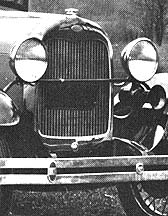
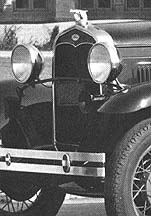
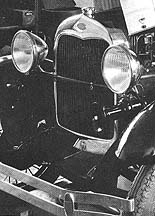
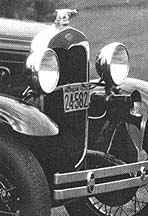
Take a look at the following pictures, from left to right, of 1928, 1929, 1930, and 1931 cars:
|
 |
 |
|
It's easy determine whether the Model A is an "early" or 1928-1929 year model or a "late" 1930-1931 model by looking at the shape of the radiator shell. On the early cars, the shell is shorter and lacks the painted lower section. It's also pretty easy to tell a 1930 from a 1931 - notice that the 1930 shell has a smooth top section, while the 1931 shell has a painted top section. However, the 1928 and 1929 shell and radiator look identical.
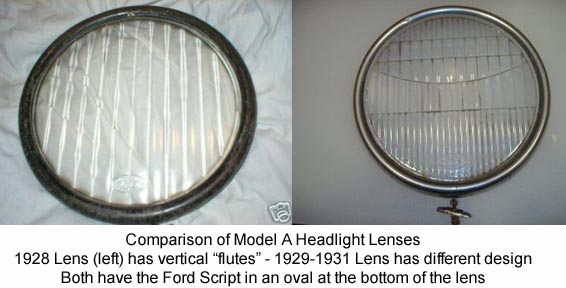
Instead of looking there, look closely at the headlights and center bumper clamp. It's hard to tell in the photographs above, but the 1928 headlights had vertical fluted lenses and round center bumper clamps. 1929 cars (and 1930-1931 cars too) had Twolite lenses and an oval center clamp on the bumper. The 1928-1929 headlights were "acorn" shaped, while the later 1930-1931 lights were "cup" shaped. Sharp eyes will also note that the early headlight bar was straight between the headlights while the later one had a slight upward bow. Compare the headlights in the 1929 and 1931 photographs and see if you can spot the differences.
Finally, front bumpers on 1928-1929 vehicles had a reverse bend at the ends where the later 1930-1931 cars had gently curved ends. Compare the center two photos - the 1929 and 1930 cars - and you'll see the difference. Once you learn how to put all these things together, you'll be able to identify the year of a Model A quickly with a high degree of accuracy. But don't forget, there are some exceptions to these general guidelines, so you may not want to bet a lot of money on your identification!
Fine Tuning -- Is it a 1928 or 1929?
At first glance, 1928-29 cars look identical. You'll have to look closely to tell the difference. The single tail light of the 1928 cars was shaped like a tuna can and is referred to as a "drum" tail light. This design was carried over to the early 1929 models until the more common "tea cup" design was introduced. That design was used until the end of production. The drum tail light bracket was forged steel and was bolted to the bottom of the body on the driver's side. The tea cup bracket was stamped steel and was bolted to the rear fender on the driver's side. If you find a left-rear fender with no mounting holes for a tail light, it's probably a 1928 fender.
1928 cars originally had red steering wheels. These gave way to black wheels in 1929. 1928 roadsters, pickups, and phaetons lacked outside door handles but 1929 roadsters and phaetons were so equipped.
Headlight lenses can also help determine the year. 1928 lenses were a carryover from Model T days. The design of the lens was changed for 1929 and continued thorough the end of production.
Is it a 1930 or 1931?
This one is tricky, but in general, you can tell a 1930 from a 1931 by looking at the radiator shell. 1930 cars had a stainless shell with a painted insert at the bottom and a blue Ford logo. 1931 cars had a painted upper insert with a stainless steel Ford logo.
Click Here for a photo comparing the 1930-31 radiator shells
Another difference between 1930 and 1931 vehicles are the running board splash aprons. The 1930 vehicles used a two-piece splash apron. The main piece was integral with the running board, and the small front section was bolted to this assembly. The 1931 vehicles used a separate, one-piece splash apron that bolted to the running boards. However, the transition period commenced in October 1930 and continued to year end.
Click Here for a photo comparing the 1930-31 fender/running boards.
Splitting Hairs --
Early 1930 versus Late 1930
![[1928-30 Instrument Panel]](photos/i-panel-2830.jpg) |
![[1930-31 Instrument Panel]](photos/i-panel-3031.jpg) |
From the beginning of production, the instrument panel in the vehicle was diamond shaped with a smooth face, an oval speedometer, and a light protruding from the center.
Starting around June 1930, a new design was used, shaped more like an oval, with horizontal ribs, and a round speedometer. The dash light was moved above the panel, just under the dash rail.
Early 1931 versus Late 1931
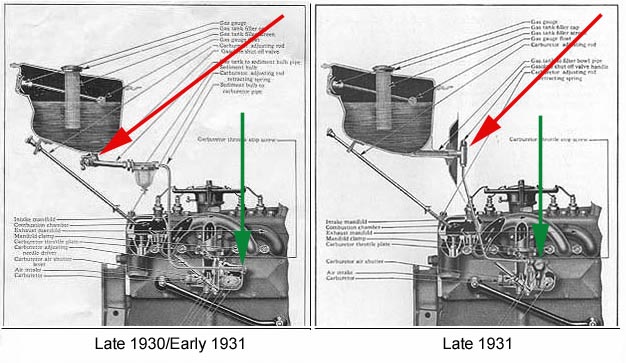
In May 1931, the area where the gasoline line came thru the firewall (passenger side) was indented so that the gasoline shut-off switch could be mounted in the engine compartment instead of inside the car. The sediment bowl was redesigned so that it could be mounted to the side of a specially designed Zenith carburetor.
In the photo below, the red arrows show the location of the fuel shut off valves. The green arrows show the fuel inlet on the carburetors.
We hope that these tips help you to identify the Model A's that you see. They're really NOT all the same!
